
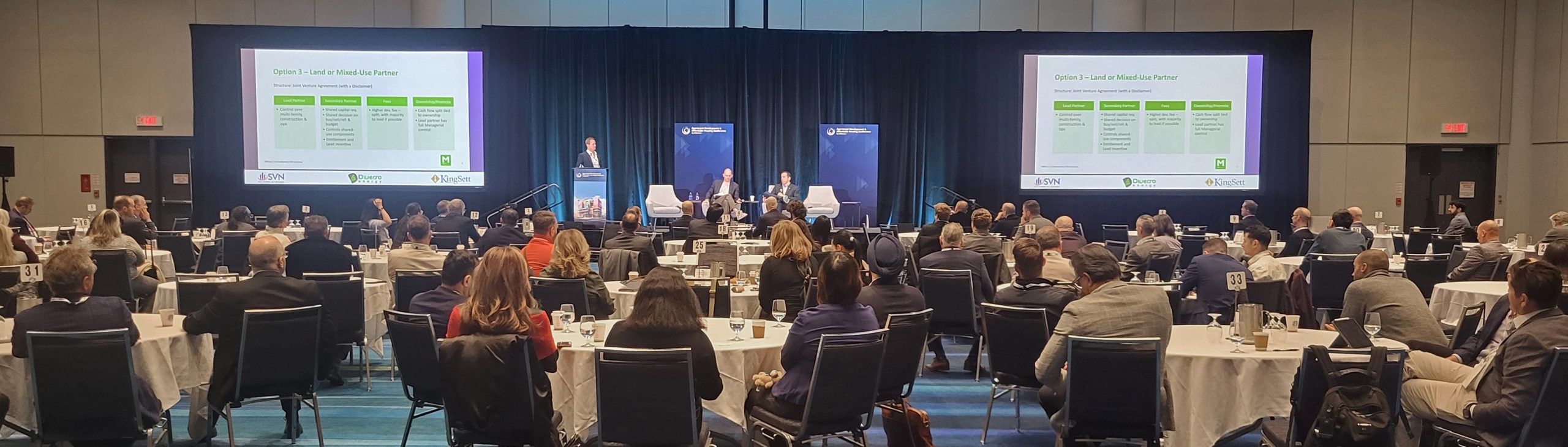
Key Highlights, Insights & What Comes Next
This year’s Apartment Development & Affordable Housing Conference brought together leaders, emerging voices, and frontline practitioners for a day of timely insights and practical strategies. Across many standout sessions, attendees gained a deeper understanding of where the industry is heading—and what it will take to move projects forward in today’s challenging environment.
Below are the core themes and takeaways from the conference.
Apartment Marketplace Pulse – a view from the street, not the c-suite
This conversation brought together practitioners who work closest to the ground—those who interact with residents, leasing teams, service managers, and day-to-day operations.
Key Takeaways:
-
The “street view” paints a different picture than macro-level reports. Renters’ concerns revolve around stability, quality, and lifestyle—not just pricing.
-
Leasing today requires empathy and adaptability. Teams reported higher interest in shorter terms, flexibility, and transparency around fees and policies.
-
Operational excellence is becoming a competitive differentiator. Buildings that perform well operationally lease faster, retain longer, and withstand market pressures better.
-
Community-building is a growing expectation. Residents want connection, amenities with purpose, and management that feels human.
This session underscored that frontline insights must help guide the decisions made in boardrooms.
Private Equity & Joint Ventures
This session unpacked the evolving landscape of private equity, joint ventures, and capital partnerships—an area undergoing major transformation as interest rates, construction costs, and lender expectations continue to shift.
Key Takeaways:
-
Partnership structures are becoming more creative, flexible, and performance-aligned. Developers are looking beyond traditional models to unlock capital and share risk intelligently.
-
Institutional capital is still active—but far more selective. Sponsors with strong track records, transparent governance, and conservative underwriting are rising to the top.
-
Co-development is gaining momentum, especially for groups looking to maintain control while accessing deeper capital pools.
-
Successful JVs rely on clarity up front: roles, responsibilities, reporting, exit strategies, and waterfall structures must be established early to avoid friction later.
This session reinforced a central message: in today’s environment, the right partnerships matter more than ever.
It was a practical, highly engaging walk-through that many attendees said was one of the most actionable portions of the conference.
Apartment Pro Forma & Financing
Our morning case study broke down an actual development scenario, exploring feasibility, capital stack assumptions, and recalibrated expectations in today’s economic environment.
Key Takeaways:
-
Rising costs demand smarter design and value engineering—without compromising long-term asset quality.
-
Proformas now require more sensitivity testing. Developers must model multiple rent outcomes, interest rate paths, and construction timelines.
-
MLI Select, ACLP, and creative financing remain powerful tools, but each comes with unique constraints that must be evaluated early.
-
The winning formula is discipline + creativity. The developer in the case study succeeded not by cutting corners, but by rethinking the fundamentals.
It was a practical, highly engaging walk-through that many attendees said was one of the most actionable portions of the conference.
Essentials of Feasibility, Design & Lease-Up
This practical session walked attendees through the fundamentals of turning a concept into a financially viable, leasable apartment building—a process that has grown more complex in today’s market.
Key Takeaways:
-
Feasibility must be grounded in realism. Developers are stress-testing proformas more aggressively, accounting for delays, material cost volatility, and financing shifts.
-
Design is returning to fundamentals. Efficiency, livability, long-term durability, and operational simplicity are outweighing flashier architectural features.
-
Lease-up now requires an integrated plan. Marketing, pricing, tenant profiles, incentives, and operational readiness must be aligned before the first hard-hat tour.
-
Cross-department collaboration is essential. Feasibility, design, construction, and leasing teams must communicate early and often to avoid costly misalignments.
This session distilled the development process into a clear message: success requires discipline, alignment, and early planning.
The Condo Pivot to Rental: A Rising Movement
The final session addressed one of the most important shifts in the Canadian housing market: developers pivoting condo sites into purpose-built rental.
Key Takeaways:
-
Many condo proformas no longer pencil, prompting developers to reconsider their highest and best use.
-
Purpose-built rental offers long-term stability, especially when paired with CMHC programs such as MLI Select or ACLP.
-
Design changes are necessary, including more efficient common areas, smaller average unit sizes, improved durability, and operational-friendly layouts.
-
Investors are taking notice. Rental is seen as a resilient asset with strong fundamentals, particularly in supply-constrained markets.
-
This is becoming a national trend, driven by economic pressure, demographic shifts, and policy incentives.
The discussion made one thing clear: the condo-to-rental pivot is no longer an outlier—it’s a strategic response shaping the future of Canadian development.
A Successful Event—And a Big Thank You
We are incredibly grateful for the enthusiastic participation, thoughtful discussions, and overwhelmingly positive feedback from this year’s attendees.
Your engagement confirms what we’ve believed for years: this event fills a critical need in the industry.
The conversations sparked yesterday will continue to influence how developers, owners, lenders, and policymakers approach apartment development and affordability challenges across the country.
We’re excited to build on this momentum—and we’re already looking forward to seeing you again next year.
📅 Save the date: December 1, 2026
Thank you once again for being part of this year’s conference.
We’ll see you next year—with even more insights, strategies, and industry-shaping conversations.